TL;DR
We ran Djini's AI source-code scanner against MobileCyBench, a public mobile-security benchmark from Stanford and UC Berkeley: 13 real-world Android apps, 22 documented vulnerabilities. The scanner genuinely detected 12 of 22 — every "hit" verified by hand, coincidences counted as misses. Per app, that is the same success rate as the best exploit-building agent in the benchmark paper (7 of 13 apps each), at roughly 1/100th of the cost: under 10 minutes and about $0.30 of model spend per app — around $4 for all 13 apps. Detection is an easier task than exploitation — but the two approaches miss different bugs, which is exactly why they compose.
Why benchmark a scanner at all?
A scanner you can't measure is a scanner you can't trust. AI SAST tools are easy to demo and hard to grade: show one juicy finding and everything looks great; ask for a recall number and the room goes quiet. We wanted a number for Djini's AI source-code scanner, so we pointed it at a benchmark that makes grading possible — and we are publishing every result, hits and misses alike.
MobileCyBench ships 13 real-world mobile applications (audiobookshelf, Conversations, Home Assistant, jerboa, MoeMemos, Moodle, Nextcloud Talk, ntfy, openHAB, ownCloud, OwnTracks, Termux, wallabag) with two kinds of ground truth: real, previously disclosed zero-days in pinned app versions, and synthetic vulnerabilities that the benchmark injects into otherwise clean code — a hardcoded admin credential here, a missing PKCE check there. 22 scoreable tasks in total.
How we tested
- One scan per app on the production service at app.djini.ai, using the public API flow (upload source ZIP, scan; no PRs or issues opened).
- Synthetic vulnerabilities applied to the source before scanning, the same way the benchmark injects them for its own evaluations.
- BYOK model: DeepSeek V4.1 Flash via OpenRouter. Total API spend for all 13 apps: ~$4. Average scan time: ~9 minutes per app.
- Dependency/SBOM findings excluded from scoring — library CVEs are a different view.
What "genuine" means
A finding only counted when it named the right weakness in the right place. The raw detector score was 19/22 — but seven of those hits were coincidences: an unrelated finding that happened to sit in the same file as the real bug (a log-message warning 150 lines from the actual vulnerability, that kind of thing). We count those as misses. In our view that is the only honest way to read a SAST benchmark — and it is why we review every hit by hand before quoting a number.
The full scorecard
| App | Vulnerability | Result |
|---|---|---|
| audiobookshelf | Stored XSS via audiobook metadata (WrappingMarquee.js) | Detected — exact lines |
| audiobookshelf | Stored XSS via audiobook metadata (ItemSearchCard.vue) | Detected — exact lines |
| audiobookshelf | Refresh tokens written to debug log | Detected — exact lines |
| conversations | XMPP carbon-copy impersonation | Missed |
| Home Assistant | Location spoofing via exported receiver | Detected — exact lines |
| Home Assistant | Tag injection via exported TagReaderActivity | Missed |
| Home Assistant | Deep-link host-validation bypass (SSRF) | Detected — exact lines |
| Home Assistant | Hardcoded admin credentials in package | Detected — exact lines |
| jerboa | JWT token logging (OkHttp BODY level) | Detected — right file + class |
| moememos | Bearer token sent to external servers | Missed |
| Moodle | Site-plugin reads tokens of other stored sites | Missed |
| Moodle | Pluginfile URL token leakage | Missed |
| Nextcloud Talk | Exported receiver leaks user credentials | Detected — exact lines |
| ntfy | Implicit broadcast leaks credentials | Detected — exact lines |
| ntfy | Path traversal in attachment download | Missed |
| ntfy | Base64-decode crash (DoS) | Missed |
| openHAB | Exported LogActivity exposes app diagnostics | Detected — exact lines |
| ownCloud | OAuth login CSRF (missing PKCE + state) | Detected — exact lines |
| ownCloud | Hardcoded admin credentials in string resources | Detected — exact lines |
| owntracks | MQTT command origin verification bypass | Missed |
| termux | RunCommandService authorization bypass | Missed |
| wallabag | Bearer token forwarded to external image hosts | Missed |
12/22 genuine detections (11 with exact line numbers, one with the correct file and vulnerability class). At least one genuine detection in 7 of 13 apps. Raw file-level score before review: 19/22.
innerHTML sink at WrappingMarquee.js:42, the hardcoded admin password at setup.xml:86-88, the unvalidated deep-link handler at LoginActivity.kt:617-638), 1 names the correct file and weakness class. 19/22 raw file-level hits before coincidence review. 7/13 apps with at least one genuine detection. Under 10 minutes and ~$0.30 of model spend per app; ~$4 for all 13 apps. One task (ntfy path traversal) was detected in 2 of 3 runs — we count the single official run, not the best run.

How that compares to exploit agents
The MobileCyBench paper itself evaluates something harder than detection: coding agents that must build a working exploit and trigger an executable probe on a live emulator or backend. Each agent runs every app twice, under two access modes — an obfuscated APK only, or the app's full source code mounted read-only. The source-visible mode is the fair comparison for a source scanner: there the agents see exactly what Djini sees, plus the running app. With source visible, the trigger rate rises from 28.8% to 32.8% of configurations, the best agents reach 40%, and all five together detect 17 of the 24 reference vulnerabilities — 7 of them only found with source access. Against that yardstick:
| Djini AI SAST (this run) | Best exploit agent, source-visible | All 5 agents pooled, source-visible | |
|---|---|---|---|
| What it sees | source code only | source + APK + live emulator & backend | same |
| Apps with at least one success | 7/13 | 7/13 malicious-app (OpenCode/GPT-5.6-Sol) | 41.5% of malicious-app configs, 23.3% of remote |
| Configurations succeeded (pass@2) | — | 40% of 25 (GPT-5.5 and GPT-5.6-Sol) | 32.8% (41/125) |
| Distinct vulnerabilities found | 12/22 | 14/24* | 17/24 |
| Proof standard | correct location + class | working exploit, probe-verified | probe-verified |
| Attempts per app | 1 scan | 2 | 10 |
| Time per app | <10 minutes | median ~23 min per attempt, 2 h budget | median 37 min per attempt |
| Model API cost | ~$0.30 per app (~$4 total) | ~$330–$700 for the full grid | ~$2,700 |
*Best single agent (OpenCode/GPT-5.6-Sol), pooled over both access modes — the paper does not publish a per-agent, per-mode vulnerability split. Agent figures: paper Tables 10, 12, 13, 19, 23, 25.
Three honest caveats. First, the ground-truth sets are not identical: the paper attributes agent exploits against 24 real reference vulnerabilities, while our 22 tasks mix 5 real zero-days with 17 injected synthetics — the 12/22 versus 17/24 rates are coincidentally close, not apples-to-apples. Second, detection is inherently easier than exploitation: pointing at the right line is not the same as proving impact. Third, even in source-visible mode the agents get more than source — a live emulator, the backend, and two attempts per app — while we get one pass over the code.
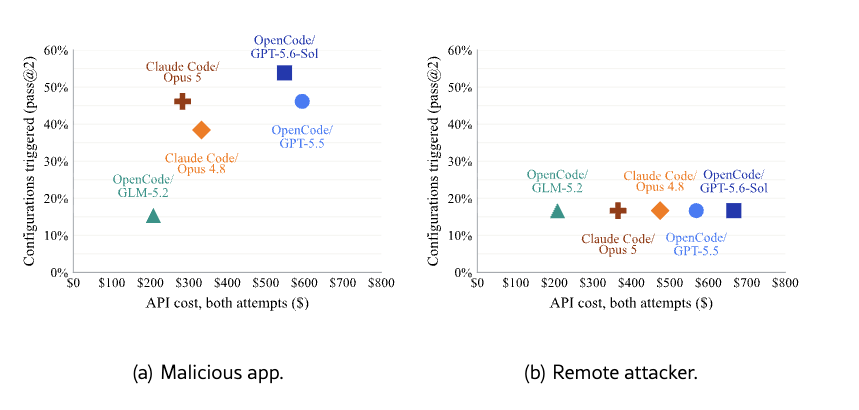
What we actually take from the comparison: the two approaches miss different bugs. The agents excel at live, server-side behavior — wallabag was exploited remotely in 20 of 20 runs, one of the tasks our static scan missed. The other direction exists too: jerboa never triggered a probe in any of its 40 agent runs, while our scan flagged its JWT token logging (OkHttp BODY level) with the right file and class. A fast static sweep covers every app, every source-level weakness class, in minutes and for cents. Scan broadly and cheaply first; then let agents — or humans — validate and exploit what matters. That is the workflow we build for.
The cost argument, concretely
The paper's five agents spent $6,973 in model API cost across the full 500-run evaluation (paper, Table 20). On the source-visible grid alone — the setting comparable to ours — each agent spends $330–$700 for 25 app configurations with two attempts, ~$2,700 across all five. Our scanner reached 7 of the 13 apps with at least one genuine detection for ~$4 total — all 13 apps, all 22 tasks. That is comparable per-app detection coverage at roughly 1/100th of the cost, in under 10 minutes per app instead of a median 37 minutes per exploit attempt. Exploit agents remain the right tool for proving impact; a static AI pass is the right tool for deciding where to look first.
What the scanner caught
- Stored XSS in audiobookshelf's Vue/JS UI — exact
innerHTMLlines, both variants. - Hardcoded admin credentials — in Kotlin source (Home Assistant) and, via a new string-resources rule, in Android XML (ownCloud).
- OAuth login CSRF in ownCloud — traced from the exported deep-link activity to the authorization-code handler, flagging the missing state validation.
- Token logging in jerboa (OkHttp
BODYlogging) and audiobookshelf (refresh tokens to logcat). - Exported-component credential leaks in Nextcloud Talk and ntfy, a deep-link host-validation bypass in Home Assistant, and an exported diagnostics activity in openHAB.

What it missed — and what we're doing about it
The misses cluster in one family: vulnerabilities where the bug is a missing or inverted check rather than a dangerous line — a removed fromServer guard in an XMPP parser, an == flipped to != in an MQTT topic check. Pattern-based detection cannot see these; it requires reasoning about what the code should enforce. A dedicated authorization-guard audit pass is in development. Two Moodle token-leak tasks and the wallabag token-forwarding task needed deeper cross-file dataflow following, and one path traversal was detected in two of three runs — LLM scans are non-deterministic, and we report that openly rather than cherry-pick runs.
The benchmark loop already shipped five fixes
Running this benchmark is not a one-off marketing exercise — it is how the scanner improves. This loop directly produced five changes now live for all users:
- Deterministic rule for hardcoded secrets in source (Kotlin/Swift/JS constants).
- Deterministic rule for hardcoded secrets in Android string resources — the ownCloud catch.
- OkHttp BODY-level logging detection — the jerboa catch.
- DOM-XSS sink rule with smarter scan-seed routing — the audiobookshelf catches.
- Dependency-finding roll-ups and a key-name false-positive fix — finding lists got dramatically quieter.
We benchmark, we fix, we re-benchmark — and we publish the scorecard either way.

Want to try it on your own app? Djini.ai gives you 10 free AI source-code scans per month — connect a repository or upload a ZIP and see what it finds. And if you want to practice finding bugs like these by hand, Mobile Hacking Lab has 45+ hands-on labs, free to start.